

A single-phase motor refers to an asynchronous motor that operates on a 220V single-phase AC power supply. Due to the convenience and cost-effectiveness of the 220V power supply, which is also the standard voltage for household electricity, single-phase motors are widely used in production and closely related to daily life. As living standards continue to improve, the demand for single-phase motors in household appliances has also been increasing. Here, Xint Motor provides an analysis of the applications and maintenance methods of single-phase motors:
A single-phase motor generally refers to a low-power single-phase asynchronous motor powered by a single-phase AC supply (AC 220V). This type of motor typically has two-phase windings on the stator and a standard squirrel-cage rotor. The distribution of the two-phase windings on the stator and the power supply conditions can generate different starting and operating characteristics.
In terms of production applications, there are mini water pumps, pulp grinders, threshers, crushers, woodworking machinery, medical devices, and more. In daily life, there are electric fans, hair dryers, exhaust fans, washing machines, refrigerators, and other devices. While the variety is extensive, the power output is relatively small.
Maintenance method:
Common Motor Maintenance and Repair Center Motor Maintenance Process: Clean the stator and rotor → Replace carbon brushes or other components → Vacuum pressure impregnation with F-class insulation → Drying → Dynamic balancing.
 Notes:
 Notes:
1. The operating environment should be kept dry at all times, the motor surface should be maintained clean, and the air intake should not be obstructed by dust, fibers, or other debris.
2. When the thermal protection of the motor continuously trips, it is necessary to determine whether the fault originates from the motor, overload, or excessively low setting of the protective device. Operation can only be resumed after the fault is resolved.
3. Ensure proper lubrication of the motor during operation. Typically, the motor should have its grease replenished or replaced after approximately 5,000 hours of operation. If overheating of the bearings or deterioration of the lubricant is detected during operation, promptly replace the grease. When changing the grease, remove the old lubricant and clean the oil grooves in the bearings and bearing covers with gasoline. Then, fill the cavity between the inner and outer rings of the bearing with ZL-3 lithium-based grease to 1/2 (for 2 poles) or 2/3 (for 4, 6, and 8 poles) of the space.
4. When the bearing reaches the end of its service life, the vibration and noise of the motor operation will increase. The bearing should be replaced when the radial clearance reaches a certain value.
5. When disassembling the motor, the rotor can be removed from either the shaft extension end or the non-extension end. If there is no need to remove the fan, it is more convenient to take out the rotor from the non-shaft extension end. During the extraction of the rotor from the stator, care must be taken to avoid damaging the stator windings or insulation devices.
6. When replacing the winding, it is necessary to record the original winding's form, dimensions, number of turns, wire gauge, etc. If these data are lost, they should be obtained from the manufacturer. Arbitrarily altering the original designed winding often leads to the deterioration of one or several motor performance parameters, or even renders the motor unusable.
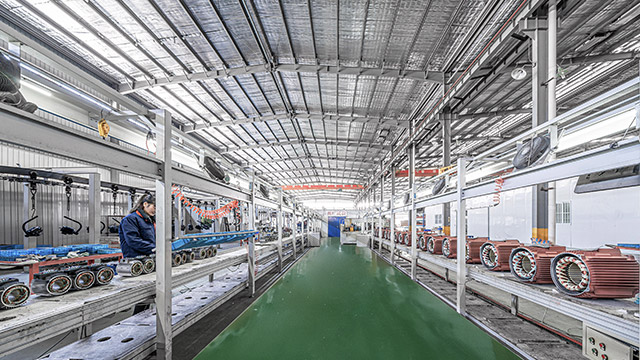
Xint Electric Motors are equipped with frequency conversion speed regulation and energy-saving devices, featuring low vibration and noise reduction design. Their energy efficiency level complies with the efficiency requirements specified in GB18613 standards, offering high efficiency, low noise, energy conservation, and reduced consumption, effectively helping customers save on equipment operation costs. The company has introduced automated high-precision production equipment such as CNC lathes, wire cutting machines, CNC grinders, and CNC milling machines. With its own testing and inspection center, it possesses dynamic balancing and other testing equipment, ensuring precise positioning and guaranteeing high product accuracy.