

How to synchronize variable frequency motors and electromagnetic speed regulating motors? What should we do when installing a device that uses variable frequency drive and synchronizes with another device that uses electromagnetic speed regulation and has a speed generator on the motor head during on-site installation? What needs to be added to convert the AC speed signal emitted by the tachometer generator into the standard DC speed given signal recognized by the frequency converter? Here, Xinte Motor editor can help solve the synchronization problem between variable frequency motors and electromagnetic speed regulating motors:
Installing an encoder expansion board on the frequency converter can solve the problem smoothly by sending the electromagnetic speed measurement signal to the frequency converter. Next, Xinte Electric's editor will take you to learn more about electromagnetic speed control motors and variable frequency speed control motors.
The difference between electromagnetic speed regulation motor and variable frequency speed regulation motor:
1. Electromagnetic speed regulating motor
Electromagnetic speed regulating motor, consisting of a single speed or multi speed squirrel type asynchronous motor and an electromagnetic slip clutch.
Electromagnetic speed regulating asynchronous motor (slip motor), also known as slip motor, is a constant torque AC continuously variable speed motor. Due to its wide speed range, smooth speed adjustment, high starting torque, low control power, negative speed feedback, and high mechanical characteristics and hardness in automatic adjustment systems, it has been widely used in printing machines and staplers, wireless binding, high-frequency drying linkage machines, and chain furnace grate control.
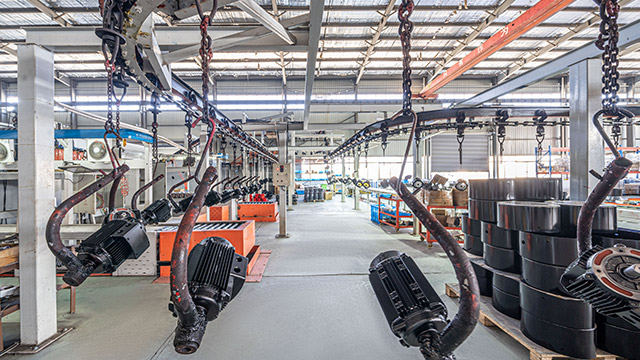 2. Variable frequency speed regulating motor
 2. Variable frequency speed regulating motor
Variable frequency speed regulating motor is a general term for electric motors driven by frequency converters.
Variable frequency speed regulating motor, abbreviated as variable frequency motor, is a general term for electric motors driven by frequency converters. In fact, the motor designed for the frequency converter is a dedicated motor for frequency conversion. The motor can achieve different speeds and torques under the drive of the frequency converter to adapt to changes in load requirements. Variable frequency motors have evolved from traditional squirrel cage motors, replacing traditional motor fans with independent fans and improving the insulation performance of motor windings. In situations with low requirements such as operating at rated frequency with low power and frequency, ordinary squirrel cage motors can be used instead.
The speed regulation and control of electric motors are one of the fundamental technologies for various types of machinery in industry and agriculture, as well as office and household electrical equipment. With the amazing development of power electronics technology and microelectronics technology, the use of "dedicated variable frequency induction motor+frequency converter" AC speed regulation method is leading a revolution in the field of speed regulation that replaces traditional speed regulation methods with its good performance and economy.
Xinte Motor is equipped with a variable frequency speed regulation energy-saving device and a low vibration and noise reduction design. Its energy efficiency level meets the efficiency requirements of GB18613 standard, with high energy efficiency and low noise, energy saving and consumption reduction, effectively helping customers save equipment operating costs. The company has industry-leading automated CNC production equipment, a modern type testing center in China, a sound quality assurance system, procurement control system, and modern management system. The comprehensive performance of its products has reached the level of similar products at home and abroad.